

Forex Trading isn’t a casino game anymore; it’s a high-speed chess match run on code, and picking the right AI decides who keeps the king.
Banks want safety, hedge funds want alpha, and market makers want speed; the best system fits risk, budget, and backbone from day one.
AI for Conservative Institutional Investors
Risk management, portfolio optimization, and regulatory compliance.
Machine Learning Systems Suited to Central Banks
Policy alignment, stability monitoring, and economic forecasting.
High-Frequency Trading AI for Liquidity Providers
Market making, low latency, and execution speed.
Which AI Fits Your Risk Profile?
Foreign exchange markets move fast, but not every player in Forex Trading runs at the same speed. Some chase alpha; others guard reserves like gold. From pension funds to liquidity providers, AI in foreign exchange trading adapts to risk appetite, compliance rules, and capital goals. Let’s break down how different profiles approach Forex, FX trading, and currency trading with smart systems.
AI for Conservative Institutional Investors
In institutional Forex Trading, caution pays the bills. Pension funds and insurers build around:
Risk management
Portfolio optimization
Regulatory compliance
At the core sits a structured framework:
Capital Shield
1.1 Enforce daily VaR constraints1.2 Stress-test under macro shocks using Macroeconomic analysis1.3 Maintain liquidity buffers for redemption cyclesStability Engine
2.1 Apply long-horizon Long-term strategy models2.2 Target Stable returns over speculative gains2.3 Prioritize Capital preservation across diversified currency basketsGovernance Layer
3.1 Automated MiFID II reporting3.2 OMS/EMS integration3.3 Audit-ready trade logs
For desks engaged in Forex Trading at scale, this setup keeps currency trading steady, not flashy. Platforms like EasyCashBackFx support cost efficiency through forex cashback, helping institutions retain margin without increasing risk.
Machine Learning Systems Suited to Central Banks
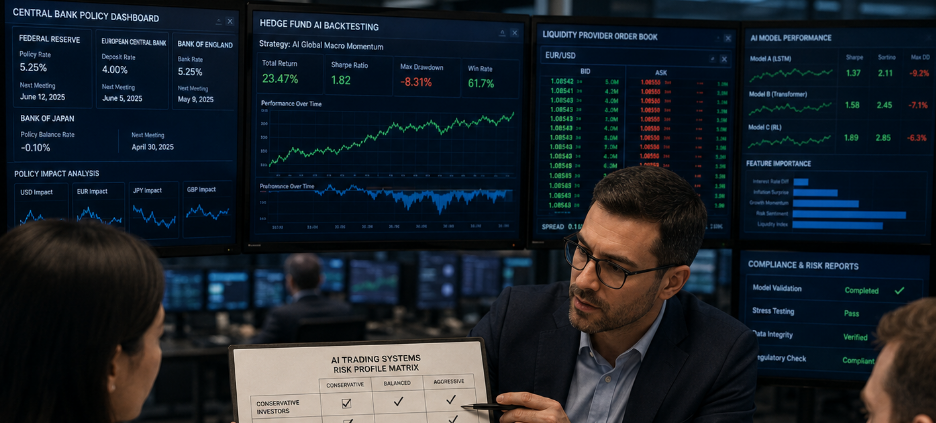
Central banks approach Forex Trading through policy lenses and data depth.
Core Functional Blocks
Policy Alignment
1.1 Monetary policy calibration1.2 Interest rate modeling1.3 Policy simulationStability Monitoring
2.1 Financial stability dashboards2.2 Systemic risk analysis2.3 Capital flow trackingForecasting Stack
3.1 Economic forecasting models3.2 Inflation prediction engines3.3 Scenario-based FX reserve optimization
Sample Macro-FX Modeling Snapshot (2025)
| Indicator | 2023 Avg | 2024 Avg | 2025 Projection | Model Impact Score |
|---|---|---|---|---|
| Inflation (%) | 6.8 | 4.9 | 3.7 | 0.82 |
| Policy Rate (%) | 4.5 | 5.1 | 4.3 | 0.76 |
| FX Reserves ($bn) | 820 | 845 | 870 | 0.69 |
| Capital Flows ($bn) | -120 | -45 | 15 | 0.74 |
| GDP Growth (%) | 2.1 | 2.8 | 3.2 | 0.71 |
In foreign exchange trading at this level, AI guides spot and forward intervention timing while protecting reserve value. The scale of the market matters here: the latest BIS survey reported by Reuters showed global currency trading reached a record $9.6 trillion a day in April 2025, reinforcing why central-bank-grade AI must prioritize stability, liquidity, and systemic risk rather than short-term speculation.
Algorithmic Trading Systems Tailored for Hedge Funds
Hedge funds treat Forex Trading like a competitive sport.
Alpha lives in:
Alpha generation
Quantitative strategies
Arbitrage
Execution stack:
Signal Layer
1.1 ML-driven factor scoring1.2 Deep Backtesting across 10+ years1.3 Risk parity balancingMarket Interface
2.1 Smart Execution algorithms (VWAP/TWAP)2.2 Market microstructure analytics2.3 Real-time slippage trackingOptimization Loop
3.1 TCA feedback3.2 Volatility-adjusted sizing3.3 Cross-asset hedging
In fast FX trading, small cost edges matter. EasyCashBackFx can trim transaction expenses through forex rebates, which compounds nicely when strategies scale.
High-Frequency Trading AI for Liquidity Providers
Liquidity providers live in milliseconds. Forex Trading here is pure speed.
Key pillars:
Market making
Low latency
Execution speed
Operational layers:
Infrastructure Core
1.1 Co-located servers1.2 Direct matching engine access1.3 Hardware accelerationOrder Book Intelligence
2.1 Real-time Order book analysis2.2 Dynamic Bid-ask spread adjustment2.3 Volatility prediction filtersInventory Control
3.1 Micro Micro-arbitrage scanning3.2 Position netting every few seconds3.3 Spread widening during shocks
In this corner of currency trading, margins are thin but consistent. AI keeps quotes tight, risk contained, and liquidity flowing across global Forex markets.
Rule-Based vs. ML-Based AI
Forex Trading moves fast. One minute you rely on clear logic, the next minute the market flips. In Forex trading, traders often debate between structured systems and adaptive models. Let’s break down how rule-driven engines and machine learning tools shape modern currency trading.
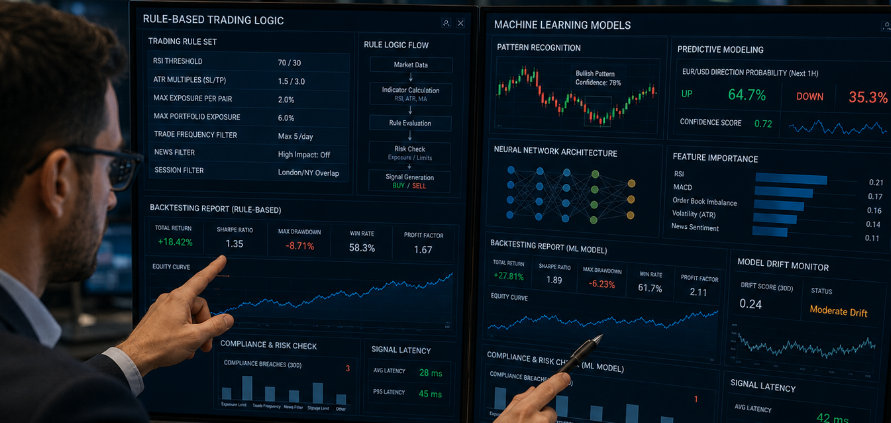
Rule-Based AI
In Forex Trading systems built on Expert systems logic, decisions follow Predefined rules written through Explicit programming. No guessing. Just structure.
Core Logic Foundation
1.1 Knowledge Source1.2 Decision MechanicsApplies Logical conditions
Sets numeric Thresholds (RSI 70/30, ATR multiples)
Executes mechanical Heuristics
Built from Human expertise
Encodes trading desk experience
Uses tested FX playbooks
Operational Flow in Currency Trading
2.1 Signal Generation2.2 Compliance LayerRisk caps
Exposure limits
Trade frequency filters
If EUR/USD > 200 MA → Buy bias
If spread > threshold → Block trade
Performance Snapshot in Retail Forex Trading
| Metric | Rule-Based AI | Manual Trading | Hybrid Desk Model |
|---|---|---|---|
| Avg. Signal Latency (ms) | 12 | 350 | 40 |
| Backtest Stability (%) | 78 | 52 | 81 |
| Max Drawdown Control (%) | 14 | 26 | 16 |
| Compliance Breach Rate (%) | 1.2 | 4.8 | 1.5 |
| Strategy Drift (12m %) | 3 | 18 | 6 |
Structured models shine in regulated Forex trading environments. That’s why platforms like EasyCashBackFx align well with rule-governed execution, giving traders predictable cashback returns while sticking to disciplined trading logic. Traders comparing execution cost can also use a forex rebate calculator to estimate how rebates may affect long-term trading expenses.
ML-Based AI
Machine learning in Forex Trading feels different. It adapts. It studies. It reacts.
At the core are Algorithms trained on heavy Data analysis. Instead of fixed rules, Statistical models scan historical and live FX streams looking for hidden signals.
• Pattern recognition spots nonlinear price behavior
• Predictive modeling forecasts short-term volatility
• Neural networks process thousands of variables at once
In advanced currency trading setups, Machine learning and Deep learning engines adjust position sizing dynamically. When volatility spikes, exposure shrinks. When liquidity improves, models scale in.
Recent industry research supports the shift toward AI-assisted markets: the IMF notes that artificial intelligence can increase efficiency in capital markets through process automation, investment analysis, and more powerful algorithmic trading, while also requiring strong oversight as adoption grows.
Still, ML models require tight monitoring. Drift happens. Overfitting creeps in. Smart Forex trading desks combine cashback optimization from EasyCashBackFx with disciplined oversight so performance doesn’t spiral.
In online Forex trading, rule-based logic brings clarity. Machine learning brings adaptability. Most serious traders blend both—and keep refining through forex education, live data review, and repeatable trading rules.
Top 3 Risk Controls for AI FX
Forex Trading moves fast. Blink, and a currency pair shifts on fresh data or breaking news. In AI-driven FX trading, speed is power—but risk control keeps the lights on. Smart systems in foreign exchange trading rely on layered defenses to manage exposure, credit threats, and compliance pressure without slowing down execution.
Hedging Strategies to Curb Market Risk
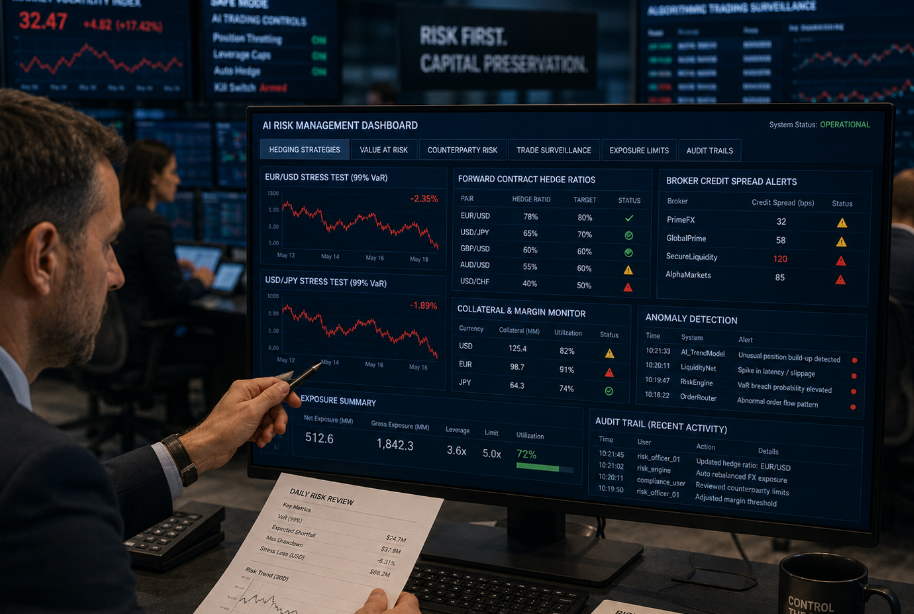
AI-driven Forex Trading engines manage exposure management through structured hedging layers:
Core Hedge Layer
Use forward contracts to lock rates on major currency pairs.
Deploy derivatives like options for flexible downside cover.
Match hedge ratios to portfolio beta for tighter portfolio protection.
Dynamic Adjustment Layer
Volatility spike detected → rebalance financial instruments mix.
Liquidity drops in FX trading → shift from options to forwards.
Correlation shifts → re-optimize cross-pair offsets.
Stress Alignment Layer
Run scenario shocks on EUR/USD and USD/JPY.
Map hedge gaps to VaR tolerance.
Recalibrate positions before London or New York open.
In plain terms, hedging in foreign exchange trading isn’t static. It adapts, sometimes hourly. A reliable economic calendar helps traders align AI signals with macro events that can suddenly reshape volatility.
Value at Risk Models for Counterparty Risk
AI models in Forex Trading break counterparty control into nested checks:
Risk Assessment Core
Measure default probability of key financial institutions.
Track real-time credit risk spreads.
Set dynamic exposure limits per broker.
Collateral and Margin Controls
Monitor collateral management buffers.
Trigger margin calls when thresholds breach.
Align with Basel capital ratios.
Stress Testing Framework
Historical simulation (2008, 2020 shocks).
Forward-looking macro stress.
Liquidity freeze scenarios tied to FX trading volumes.
This keeps foreign exchange trading desks from being blindsided by a single failing counterparty. For retail and professional traders, broker selection also matters, which is why comparing best forex brokers can support both execution quality and counterparty due diligence.
Trade Surveillance for Operational and Compliance Safety
In Forex Trading, clean execution matters as much as profit.
Transaction Monitoring Hub
Scan orders for market manipulation patterns.
Flag spoofing across algorithmic trading systems.
Maintain real-time audit trails.
Regulatory Alignment Layer
Sync reports with global regulatory bodies.
Embed KYC triggers into order flow.
Archive logs for MiFID II checks.
Anomaly Detection Engine
AI-driven data analysis across venues.
Behavioral baselines per trader.
Instant alerts on statistical outliers.
FX trading without surveillance is risky business. With structured oversight, Forex Trading becomes controlled, traceable, and far less likely to spiral into costly compliance trouble. ESMA’s algorithmic trading rules require effective systems, risk controls, testing, monitoring, and time-sequenced records for high-frequency algorithmic trading, making surveillance a core part of responsible AI FX deployment.
References
[Reuters – Global currency trading closing in on $10 trillion a day - https://www.reuters.com/business/finance/global-currency-trading-closing-10-trillion-day-2025-09-30/]
[BIS – Triennial Central Bank Survey of foreign exchange and OTC derivatives markets in 2022 - https://www.bis.org/statistics/rpfx22.htm]
[IMF – Advances in Artificial Intelligence: Implications for Capital Market Activities - https://www.imf.org/-/media/files/publications/gfsr/2024/october/english/ch3.pdf]
[ESMA – Article 17 Algorithmic Trading - https://www.esma.europa.eu/publications-and-data/interactive-single-rulebook/mifid-ii/article-17-algorithmic-trading]
[ESMA – Supervisory Briefing on Algorithmic Trading in the EU - https://www.esma.europa.eu/sites/default/files/2026-02/ESMA74-1505669079-10311_Supervisory_Briefing_on_Algorithmic_Trading_in_the_EU.pdf]
FAQ
How can Institutional Investors protect capital in Forex Trading?
Capital safety in Forex Trading is less about speed and more about discipline. Institutional Investors, Central Banks, and Investment Banks typically combine governance, infrastructure, and risk math:
Portfolio Layer
Diversify across major and emerging Currency Pairs
Balance Spot Contracts with Forward Contracts or Non-Deliverable Forwards
Apply Hedging Strategies to offset Market Risk
Risk Controls
Measure Value at Risk for market exposure
Monitor Counterparty Risk through Prime Brokers
Track Liquidity Risk during volatile sessions
Operational Shield
Integrate Order Management Systems with Execution Management Systems
Maintain Trade Surveillance aligned with MiFID II and Dodd-Frank Act
Enforce Anti-Money Laundering and Know Your Customer checks
When markets swing sharply, discipline—not prediction—preserves long-term capital.
What distinguishes rule-based systems from Machine Learning in Forex Trading?
In fast markets, the contrast becomes clear.
Rule-based models
Follow fixed conditions on Currency Pairs
React to predefined price or Economic Indicators
Easier to audit under Reporting Requirements
Machine Learning models
Train on Historical Data and Tick Data
Adapt to Real-time Data from Market Data Feeds
Refine signals using Algorithmic Trading Analytics
Across Electronic Communication Networks and Trading Platforms, Hedge Funds often combine both:
rule logic for risk boundaries, Machine Learning for alpha discovery. The tension lies in control versus adaptation—too rigid misses opportunity; too adaptive risks drift. Strong Cybersecurity Solutions and ongoing validation keep both in check.
How do Hedge Funds enhance execution quality in Forex Trading?
Performance is often decided in milliseconds.
Hedge Funds and Liquidity Providers optimize execution through a layered approach:
Execution Tactics
Volume Weighted Average Price and Time Weighted Average Price
Iceberg Orders for large Block Trades
Smart Order Routing across Matching Engines
Technology Stack
Low-latency Systems in co-located Data Centers
High-Frequency Trading modules for short-term inventory control
Cloud Computing for scalable analytics
Post-Trade Discipline
Transaction Cost Analysis
Monitoring Credit Risk and Operational Risk
Review under Trade Surveillance frameworks
In tight spreads and crowded markets, refined execution—not bold prediction—often separates steady gains from costly slippage.